

Quick Answer:
To understand HOA financial management involves three interconnected components that work together to keep your community financially healthy. Financial reports show your community's current financial position through balance sheets, income statements, and cash flow statements, all providing transparency and accountability. Budgets project anticipated income and expenses for the coming year, helping boards plan spending and set assessments appropriately. Reserves are funds set aside for future major expenses like roof replacements or parking lot resurfacing, ensuring the community can handle capital needs without special assessments. Understanding how these three elements work together brings clarity to financial decisions, helps boards communicate confidently with homeowners about money matters, and prevents financial crises. Professional HOA management companies like HOALiving provide expertise in financial reporting, budget development, and reserve planning to help boards make sound financial decisions.
Money matters intimidate many board members. Financial reports filled with unfamiliar terminology. Budget spreadsheets with competing priorities. Reserve studies recommending funding levels that seem impossible. It's easy to feel overwhelmed. Yet financial management is one of your board's most critical responsibilities. When you understand the three core components of HOA finances (reports, budgets, and reserves) the confusion disappears and confident decision-making becomes possible.
The Three Pillars of HOA Financial Management
Think of HOA financial management as a three-legged stool. Remove one leg and the whole structure collapses. Financial reports show where you've been. Budgets show where you're going. Reserves ensure you can get there without financial crisis. Each serves a distinct purpose, and each requires board understanding.
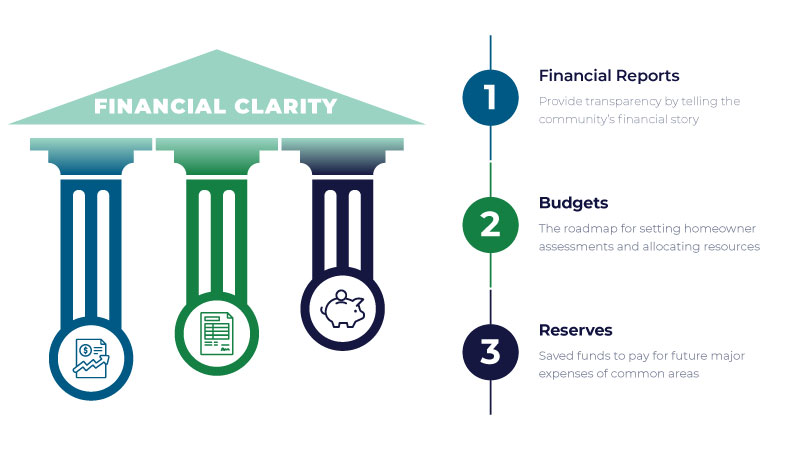
Financial Reports: Understanding Your Current Position
Financial reports are the foundation of financial transparency. They tell your community's financial story: where money came from, where it went, and what remains. Most HOAs produce three primary financial reports:
Balance Sheet (Statement of Financial Position):
- Shows what your community owns (assets) and owes (liabilities)
- Reveals your community's net financial position at a specific point in time
- Includes bank accounts, reserve funds, accounts receivable from homeowners, and outstanding debts
- Helps boards understand whether the community is building financial strength or declining
Income Statement (Statement of Operations):
- Shows all money coming in and all money going out during a specific period
- Compares budgeted amounts to actual amounts, revealing where spending varied from expectations
- Identifies whether operations are running at a surplus (more income than expenses) or deficit (more expenses than income)
- Helps boards understand operational financial health month-to-month or year-to-date
Cash Flow Statement:
- Shows the actual movement of money in and out of accounts
- Reveals whether you have enough cash on hand to pay bills when due
- Identifies timing mismatches between when money arrives and when expenses are due
- Helps boards avoid cash flow crises even when the community is technically solvent
Many board members don't realize that these reports serve different purposes. A community might look financially healthy on a balance sheet but face cash flow problems. Another community might show a deficit on the income statement but have strong reserves. Understanding what each report reveals prevents misinterpretation and supports better financial decisions.
Budgets: Planning Your Financial Future

Jacob Sadler
Your budget is your community's financial roadmap for the coming year. It projects anticipated income (primarily from assessments and other revenue sources) and anticipated expenses (utilities, maintenance, insurance, management fees, and other operating costs). The budget serves multiple critical purposes that every board member should understand.
First, your budget determines the assessment amount. This is perhaps the most important budget function. The assessment must cover your operating expenses plus a reserve contribution. If expenses total $500,000 and you need to contribute $100,000 to reserves, the total budget is $600,000. Divide that by the number of homes, and you have the per-unit assessment. This fundamental relationship means that budgeting directly impacts every homeowner's financial obligation to the community.
Beyond assessment planning, your budget allocates resources to different community needs and priorities. “A community’s budget is a reflection of its priorities and goals in balance with available resources,” explains Jacob Sadler, VP of Community Management at HOALiving.
The budget creates accountability by establishing a standard against which actual spending is measured throughout the year. When actual expenses vary significantly from budgeted amounts, that variance signals either a budgeting problem (inaccurate projections) or a spending problem (expenses exceeding reasonable expectations). Either way, variance analysis helps a board understand what's happening financially.
Your budget also serves a critical communication function. “Homeowners want to know where their assessment dollars are being spent,” said Amelia Schmidt, Regional Manager with HOALiving. “A clear budget shows exactly how funds are allocated. How much goes to utilities? To maintenance? How much to management and how much to insurance? This transparency builds trust and helps homeowners understand the necessity of assessments.”

Amelia Schmidt
Finally, your budget guides decision-making when resources are limited. When boards face competing priorities and limited funds, the budget helps determine what gets funded and what gets deferred. Without a clear budget, spending decisions become arbitrary or driven by the loudest voices rather than community priorities.
Many boards struggle with budget development because they don't understand the relationship between expenses and assessments. Some boards try to keep assessments artificially low by underfunding the budget. This creates problems. You'll either run a deficit (spending more than you collect) or underfund reserves (creating future crises). Overfunding creates unnecessary financial burden on homeowners. The goal is accurate budgeting that covers legitimate community needs without excess.
Reserves: Planning for Tomorrow's Expenses
Reserves are funds set aside today to pay for tomorrow's major expenses. Your clubhouse roof won't last forever. Your parking lot will need resurfacing. Your building exterior will need painting. These capital expenses are predictable, but you just don't know exactly when they'll occur. Adequate reserve planning can ensure your community will be able to handle these expenses without special assessments that shock homeowners.
Why Reserves Matter:
- Prevent Special Assessments: Funded reserves eliminate the need for surprise assessments when major expenses arise
- Maintain Property Values: Well-maintained common areas protected by adequate reserves preserve community property values
- Provide Financial Stability: Reserves give your community financial cushion for unexpected expenses
- Demonstrate Responsible Management: Proper reserve funding shows homeowners the board is planning ahead
- Support Long-Term Planning: Reserves enable boards to schedule major maintenance strategically rather than reactively
Reserve studies are professional assessments that evaluate your community's major components (roof, parking lot, building exterior, etc.), estimate their remaining useful life, and project replacement costs. Based on this analysis, reserve studies recommend a funding percentage, typically ranging from 70% to 100% of fully funded reserves. Many communities operate at lower funding levels due to financial constraints, but understanding the recommendation helps boards make informed decisions about assessment levels.
How These Three Elements Work Together
Finally, your budget guides decision-making when resources are limited. When boards face competing priorities and limited funds, the budget helps determine what gets funded and what gets deferred. Without a clear budget, spending decisions become arbitrary or driven by the loudest voices rather than community priorities.
Many boards struggle with budget development because they don't understand the relationship between expenses and assessments. Some boards try to keep assessments artificially low by underfunding the budget. This creates problems. You'll either run a deficit (spending more than you collect) or underfund reserves (creating future crises). Overfunding creates unnecessary financial burden on homeowners. The goal is accurate budgeting that covers legitimate community needs without excess.

Common HOA Financial Management Mistakes
Many boards make financial decisions without full understanding. They approve budgets without understanding assessment implications. They defer reserve contributions to keep assessments low, creating future crises. They misinterpret financial reports, making decisions based on incomplete information. They fail to communicate financial information to homeowners, breeding distrust and opposition to necessary assessments.
How HOALiving Brings Clarity to HOA Financial Management
This is where professional HOA management makes a transformative difference. HOALiving helps boards manage their finances by preparing clear, accurate financial reports, developing realistic budgets that balance community needs with assessment levels, conducting or coordinating reserve studies and funding analysis, explaining financial information in plain language board members understand, and providing guidance on financial decisions that serve the community's long-term health.
When your board understands your financial reports, budget, and reserves, you make confident decisions about assessments and spending. You communicate with clarity to your community about money matters. And you lead with the confidence that comes from understanding your community's financial health and future needs.
Ready to master HOA financial management? Contact HOALiving today to learn how we help boards understand financial reports, develop sound budgets, and plan for reserves.