

Quick Answer:
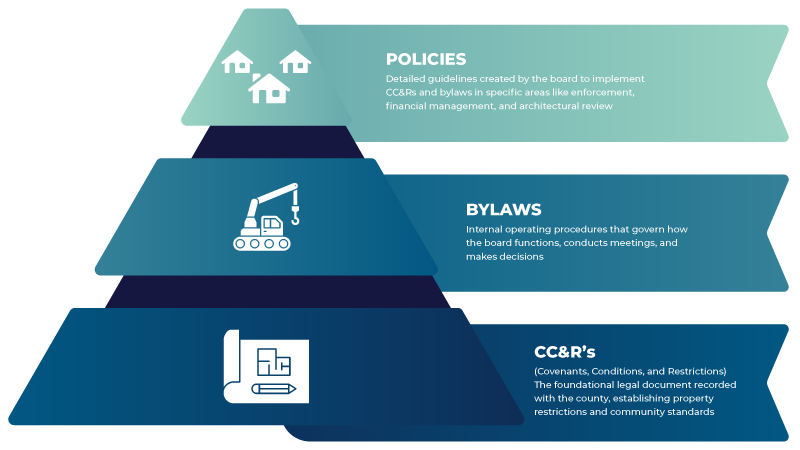
HOA governing documents form a three-tier hierarchy that defines community rules and board authority. CC&Rs (Covenants, Conditions, and Restrictions) are the foundational legal document recorded with the county, establishing property restrictions and community standards. Bylaws are internal operating procedures that govern how the board functions, conducts meetings, and makes decisions. Policies are detailed guidelines created by the board to implement CC&Rs and bylaws in specific areas like enforcement, financial management, and architectural review. Understanding this hierarchy brings clarity to governance, prevents confusion about authority levels, and helps boards make consistent, legally sound decisions. Professional HOA management companies like HOALiving provide expertise in interpreting these documents and ensuring boards understand their roles and responsibilities within this framework.
Your HOA governing documents are the rulebook for your entire community. Yet many board members struggle to understand what they actually say, how they relate to each other, or why they matter. This confusion leads to inconsistent board decisions, frustrated homeowners, and unnecessary legal exposure. The truth is simpler than most boards realize: your governing documents follow a clear hierarchy and understanding that structure brings immediate clarity to governance.
The Three-Tier Document Hierarchy
Think of your HOA's governing structure like a pyramid. At the foundation sits your CC&Rs, the most powerful document in your community. Above that sits your bylaws, which establish how your board operates. At the top are your policies, which provide specific guidance on implementing the documents below them. Each layer builds on the previous one, and each serves a distinct purpose.
CC&Rs: Your Community's Foundation
CC&Rs stand for Covenants, Conditions, and Restrictions. This is the recorded legal document that establishes the contract between the association and the owners within your community. The CC&Rs establish the fundamental relationship between the association and the property owners within the community by setting forth the basic framework for what residents can and cannot do with their properties, how the HOA is structured, what authority the board has, and how finances are managed.
Your CC&Rs typically cover:
- Property Restrictions: Exterior colors, landscaping standards, vehicle parking, pet rules, and other physical property standards
- Architectural Guidelines: Requirements for modifications, additions, or alterations to properties
- Assessment Authority: The board's power to levy assessments and special assessments on homeowners
- Enforcement Procedures: How the board addresses violations and what remedies are available
- Amendment Processes: The specific procedures required to change the CC&Rs themselves.

Because CC&Rs are recorded with the county, they bind every property owner in your community including those who've never read them. This is why CC&Rs matter so much. They're the legal backbone of everything your board does.
Many board members don't realize that if your bylaws or policies conflict with your CC&Rs, the CC&Rs always win. This is a critical distinction that prevents boards from accidentally overstepping their authority.
Bylaws: How Your Board Operates
Well written bylaws are the internal operating manual for your board. While CC&Rs establish the community framework, bylaws establish how the board runs the association. Bylaws typically address board composition and elections, meeting procedures and quorum requirements, officer roles and responsibilities, committee structure, and amendment procedures specific to bylaws.
Bylaws are generally easier to amend than CC&Rs, but they're still formal documents that usually require board and/or homeowner approval before changes. Many board members confuse bylaws with policies, thinking they can simply change bylaws whenever they want. In reality, bylaws require formal amendment procedures, just like CC&Rs.
Policies: Your Board's Implementation Tools

Policies are the most flexible layer of your governing structure. These are detailed guidelines your board creates to implement or clarify your CC&Rs and bylaws in specific operational areas. Policies might address enforcement procedures, financial management practices, architectural review processes, meeting protocols, or rules regarding the use of the amenities within your association.
Unlike CC&Rs and bylaws, policies can typically be created and modified by board vote alone, without homeowner approval. This flexibility makes policies valuable tools for addressing specific community needs. However, policies must always align with your CC&Rs and bylaws. Any policy put in place cannot contradict higher-level documents.
Why This Hierarchy Matters
Understanding document hierarchy helps both boards and homeowners see how decisions are made. When board members know which document carries the authority for a particular issue, they can act more consistently and with greater confidence. When homeowners understand that same structure, rules can feel less arbitrary because they see where the authority comes from, why the rule exists, and what process would be required to change it. That shared understanding makes governance clearer, more consistent, and more objective.
Common Confusion Points
One of the most common points of confusion comes when board members ask, “Can’t we just change this rule?” or “Can’t we just add this fee?” Sometimes the answer may be yes, but only if the change falls within the board’s authority and the proper process is followed. Other times, what seems like a simple rule change may actually require a CC&R amendment, bylaw amendment, homeowner approval, notice period, or another formal step before it can be adopted.
The opposite problem can also occur. Boards may assume a change is too difficult and avoid taking action, when the issue could be addressed through a properly adopted policy. The key is not to guess. Boards should identify which document governs the issue, confirm the amendment or approval requirements, and follow the required procedure before implementing a change. Doing so protects the board’s decision, reduces homeowner confusion, and helps ensure that new rules, fees, or procedures are properly instituted.
“The first question we teach boards to ask is not ‘Can we do this?’ but rather ‘What do the documents say?’ Understanding your association’s document framework and authority allows boards to engage in a better decision-making process” says Scott Anderson, HOALiving’s Mountain West Division President.

When boards ask the right question first, they are better positioned to choose the right path. That path may be a board-adopted policy, a bylaw amendment, a CC&R amendment, or simply clearer communication about an existing rule. The important point is that the board’s action should match the authority and process required by the governing documents.
How HOALiving Brings Clarity to Governing Documents
This is where professional HOA management makes a transformative difference. HOALiving helps boards understand their specific governing documents by clarifying the hierarchy and how each document functions, explaining which decisions require which approval levels, identifying conflicts or ambiguities in existing documents, and providing guidance on proper amendment procedures when changes are needed.
When your board truly understands your governing documents, you make better decisions faster. You avoid legal exposure from procedural errors. You communicate with confidence to your community. And you lead with the clarity that comes from knowing exactly what your authority is and how to use it responsibly.
Ready to gain clarity on your HOA's governing documents? Contact HOALiving today to learn how we help boards understand and properly implement their CC&Rs, bylaws, and policies.