
Quick Answer:
HOA board authority is defined by your governing documents and state law, and it's more limited than many board members realize. Boards can make decisions about community finances, enforce rules consistently, maintain common areas, and create policies that implement CC&Rs and bylaws. Boards cannot unilaterally change CC&Rs or bylaws, make decisions that benefit individual board members over the community, violate homeowner rights, or act outside the scope of authority granted in governing documents. Understanding these boundaries brings clarity to governance, prevents legal exposure, and helps boards focus on decisions that actually serve the community. Professional HOA management companies like HOALiving provide expertise in defining board authority, ensuring decisions stay within legal limits, and protecting boards from liability through proper governance practices.
Board members often feel caught between competing demands. Homeowners expect you to solve problems. Your CC&Rs grant you certain powers. State law imposes obligations you may not fully understand. The result? Many board members aren't entirely sure what they can and cannot decide. This uncertainty leads to poor decisions, frustrated homeowners, legal exposure, and unnecessary board burnout. The clarity you need starts with understanding exactly where your authority begins and ends.
The Foundation of Board Authority
Your board's authority comes from three sources: your CC&Rs and bylaws (which define your specific powers), state HOA law (which establishes baseline rights and responsibilities), and common law principles of fiduciary duty (which require boards to act in the community's best interest). These sources work together to create boundaries around what your board can legitimately decide.
Here's the critical point many boards miss: your authority is limited, not unlimited. You don't have the power to do whatever you think is best for the community. You have the power to do what your governing documents and state law specifically authorize. Understanding this distinction prevents boards from overstepping and creating legal liability.

What Your Board CAN Decide
Your board has legitimate authority in several key areas:
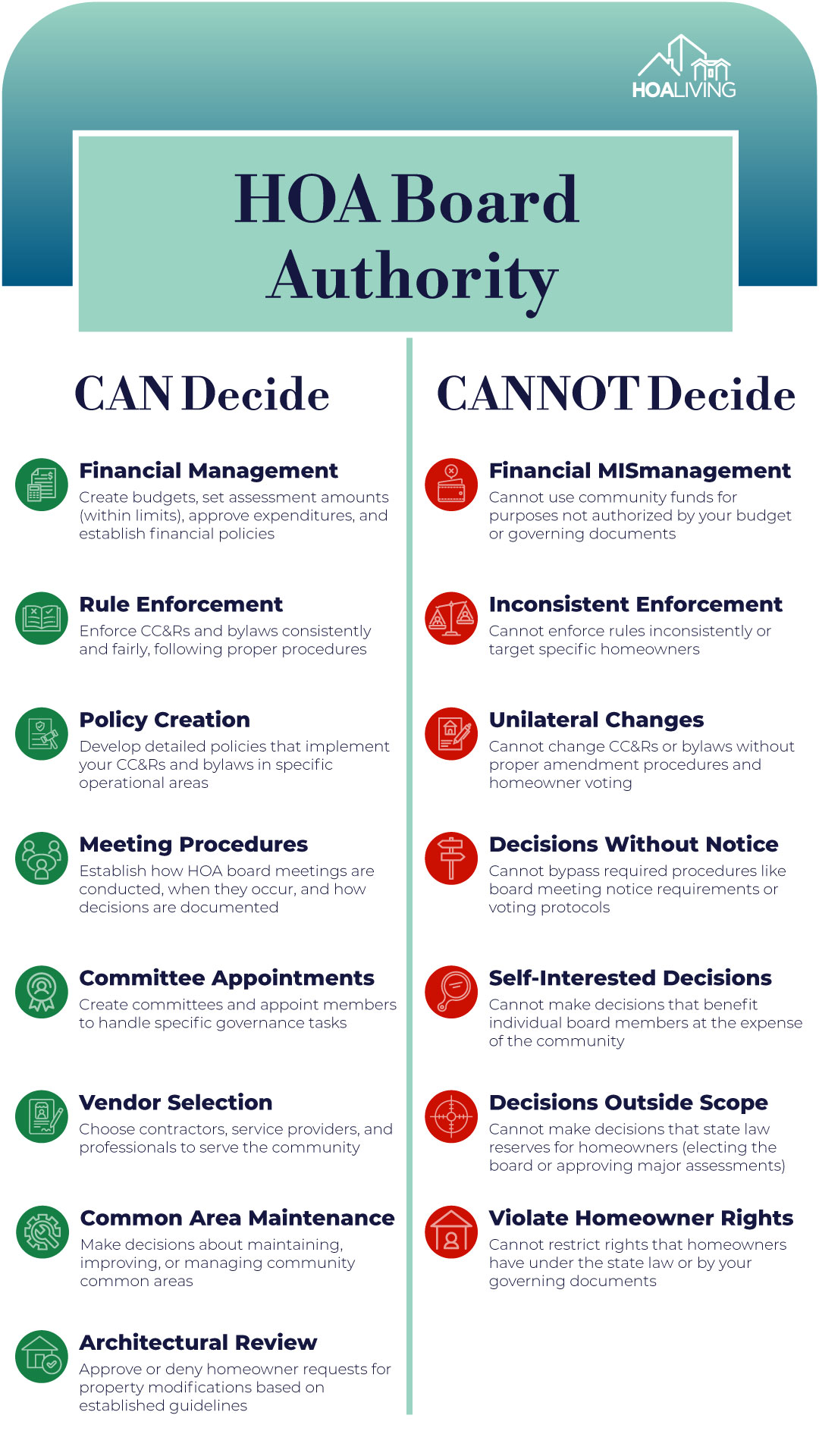
Financial Management
Create budgets, set assessment amounts (within limits), approve expenditures, and establish financial policies
Rule Enforcement
Enforce CC&Rs and bylaws consistently and fairly, following proper procedures
Common Area Maintenance
Make decisions about maintaining, improving, or managing community common areas
Policy Creation
Develop detailed policies that implement your CC&Rs and bylaws in specific operational areas
Meeting Procedures
Establish how board meetings are conducted, when they occur, and how decisions are documented
Committee Appointments
Create committees and appoint members to handle specific governance tasks
Vendor Selection
Choose contractors, service providers, and professionals to serve the community
Architectural Review
Approve or deny homeowner requests for property modifications based on established guidelines
These decisions are legitimate because they fall within the scope of authority your governing documents grant and state law permits. When boards make decisions in these areas while following proper procedures, they're exercising appropriate authority.
What Your Board CANNOT Decide
Just as important as understanding what you can decide is understanding what you cannot:
Unilateral Document Changes
You cannot change CC&Rs or bylaws without proper amendment procedures and homeowner voting
Self-Interested Decisions
You cannot make decisions that benefit individual board members at the expense of the community
Arbitrary or Discriminatory Enforcement
You cannot enforce rules inconsistently or target specific homeowners
Decisions Outside Your Scope
You cannot make decisions that state law reserves for homeowners (like electing the board or approving major assessments)
Violations of Homeowner Rights
You cannot restrict rights that homeowners have under state law or your governing documents
Financial Mismanagement
You cannot use community funds for purposes not authorized by your budget or governing documents
Decisions Without Proper Notice or Process
You cannot bypass required procedures like board meeting notice requirements or voting protocols
These limitations exist for good reason. They protect homeowners from board overreach, they protect the community from financial mismanagement, and they protect individual board members from personal liability.
The Distinction Between Board and Homeowner Authority
This is where many boards struggle. Some decisions belong to the board. Others belong to the homeowners collectively. Understanding this distinction prevents conflict and legal exposure.
Homeowners collectively (typically through voting) decide: whether to amend CC&Rs or bylaws, whether to approve major capital expenditures or special assessments, whether to elect board members, and whether to dissolve the HOA. The board decides everything else within its authority, but only the homeowners can make these fundamental community decisions.
Common Authority Mistakes
Many boards make decisions they later regret because they didn't understand their actual authority. Board members sometimes assume they can change rules without homeowner approval, only to discover their change is invalid. Others make enforcement decisions based on personal preference rather than consistent application of rules. Some approve expenditures that weren't budgeted or authorized. Others create policies that directly contradict their CC&Rs.
These mistakes happen because board members lack clarity about their authority boundaries. When you understand exactly what you can and cannot decide, you avoid these costly errors.

Fiduciary Duty: The Obligation Behind Authority
Your board authority comes with a corresponding obligation: fiduciary duty. This legal principle requires board members to act in the community's best interest, not personal interest. It means you must make informed decisions, avoid conflicts of interest, and act with the care and diligence a reasonable person would use in similar circumstances.
Fiduciary duty is the reason boards cannot make self-interested decisions, cannot ignore homeowner concerns without legitimate reason, and must follow proper procedures even when shortcuts might be faster. Understanding fiduciary duty helps board members understand why their authority is limited. It's limited to protect the community.
How HOALiving Brings Clarity to HOA Board Authority
This is where professional HOA management makes a transformative difference. HOALiving helps boards understand their authority by clarifying what your specific governing documents authorize, explaining state law requirements and limitations, identifying decisions that require homeowner approval versus board authority, reviewing proposed decisions to ensure they stay within legal bounds, and providing guidance on proper procedures to protect both the community and individual board members.
When your board understands its authority and respects its limitations, you make better decisions faster. You avoid legal exposure from overstepping. You communicate with confidence to your community. And you lead with the clarity that comes from knowing exactly what you're authorized to decide and why those boundaries exist.
Ready to understand your board's true authority? Contact HOALiving today to learn how we help boards make confident, legally sound decisions within their proper scope of authority.